NHTSA vehicle safety data
2022 Chevrolet Bolt EV Recalls, Ratings & Complaints
The 2022 Chevrolet Bolt EV has 7 NHTSA recall campaigns and 59 owner complaints on file as of November 3, 2026. Recall repairs are usually free at an authorized Chevrolet dealer.
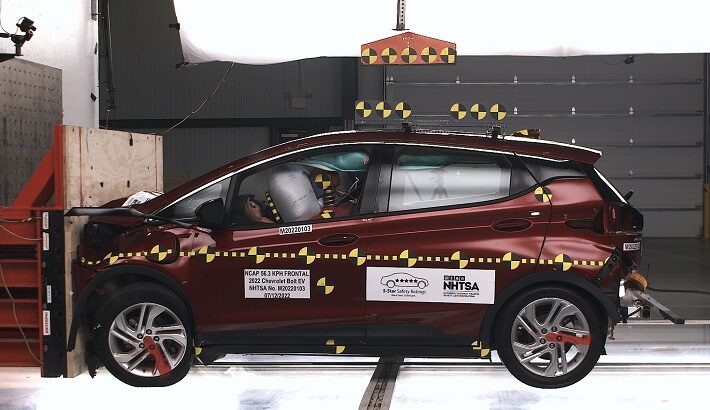
NHTSA recall and complaint data for the 2022 Chevrolet Bolt EV, plus NCAP crash-test ratings. Recall data is refreshed daily from NHTSA.
2022 Chevrolet Bolt EV owner complaints
Owners have filed 59 complaints with NHTSA about the 2022 Chevrolet Bolt EV, describing incidents dated August 9, 2021 to April 16, 2026.
Most-cited components
- Electrical System 29 complaints
- Fuel/Propulsion System 11 complaints
- Power Train 10 complaints
- Unknown or Other 8 complaints
- Engine 5 complaints
- Service Brakes 5 complaints
Of the 59 complaints on file, 3 report a crash (owner-reported, not verified by NHTSA).
Newest complaints
ODI #11741396 · Filed
Steering rack started to fail after only 15000 miles
ODI #11733483 · Filed
While driving at a low speed (approx. 5–10 mph), the front passenger-side lower ball joint suffered a catastrophic structural shear without warning. This caused the wheel assembly to collapse outward and the CV axle to pull out of the transmission. The failure caused a complete loss of steering…
ODI #11716390 · Filed
I have a faulty electric power steering, it prevents the steering wheel to return to center.
NHTSA defect investigations
NHTSA's investigations file lists the 2022 Chevrolet Bolt EV in 1 investigation. A listed model year means only that an investigation names it; it says nothing about any particular vehicle. An open investigation is not a finding that a safety defect exists, and NHTSA can close one without a recall.
- Defect Petition DP22-005: Pedestrian alert sounds
Closed August 7, 2023
High Voltage Battery May Catch Fire
NHTSA #24V812000 · Electrical System — Propulsion System — Traction Battery · NHTSA notice
Reported October 31, 2024 · General Motors, LLC
Potentially affected: 107 vehicles
Repair completion: 81.31% (latest rate the manufacturer reported to NHTSA; dataset updated November 3, 2026)
Manufacturer campaign N242470160 · Owners notified December 3, 2024
Recall group: Chevrolet Bolt EV and EUV batteries
Defect description
General Motors, LLC (GM) is recalling certain 2020-2022 Chevrolet Bolt EV and 2022 Bolt EUV vehicles previously repaired under Recall 21V-650. The installation of advanced diagnostic software may have failed. As such, the high voltage battery could catch fire when charged to full or nearly full capacity.
Safety consequence
A battery fire increases the risk of injury.
Manufacturer remedy
Owners are advised to take the following interim steps: Set the Target Charge Level feature in their vehicle to limit the charge level to 90%, charge their vehicle more frequently, avoid depleting the battery to 70 miles range remaining, park outside after charging, and do not charge the vehicle indoors overnight. Dealers will reinstall advanced diagnostic software, free of charge. Owner notification letters were mailed December 3, 2024. Owners may contact the Bolt EV Concierge Team at 1-833-382-4389. GM's number for this recall is N242470160.
Notes
Owners may also contact the National Highway Traffic Safety Administration Vehicle Safety Hotline at 1-888-327-4236 (TTY 1-800-424-9153) or go to www.nhtsa.gov.
High Voltage Battery May Catch Fire
NHTSA #24V481000 · Electrical System — Propulsion System — Traction Battery · NHTSA notice
Reported June 27, 2024 · General Motors, LLC
Potentially affected: 72 vehicles
Repair completion: 95.83% (latest rate the manufacturer reported to NHTSA; dataset updated November 3, 2026)
Manufacturer campaign N242443000 · Owners notified August 1, 2024
Recall group: Chevrolet Bolt EV and EUV batteries
Defect description
General Motors, LLC (GM) is recalling certain 2020-2022 Chevrolet Bolt EV and 2022 Chevrolet Bolt EUV vehicles that were previously remedied under recall number 21V-650. The advanced diagnostic software may have been incorrectly installed and fail to detect defective battery modules, possibly resulting in a battery fire.
Safety consequence
A battery fire increases the risk of injury.
Manufacturer remedy
Owners are advised to take the following interim steps: Set the Target Charge Level feature in their vehicle to limit the charge level to 90%, charge their vehicle more frequently, avoid depleting the battery to 70 miles range remaining, park outside after charging, and do not charge the vehicle indoors overnight. Dealers will reinstall the advanced diagnostic software, free of charge. Owner notification letters were mailed on August 1, 2024. Owners may contact the Bolt EV Concierge Team at 1-833-382-4389. GM's numbers for this recall are N242443000 and N242443002.
Notes
Owners may also contact the National Highway Traffic Safety Administration Vehicle Safety Hotline at 1-888-327-4236 (TTY 1-800-424-9153), or go to www.nhtsa.gov.
Fire Risk after Seat Belt Pretensioner Deployment
NHTSA #23V845000 · Structure — Body — Roof and Pillars · NHTSA notice
Reported December 14, 2023 · General Motors, LLC
Potentially affected: 6,771 vehicles
Repair completion: 87.92% (latest rate the manufacturer reported to NHTSA; dataset updated November 3, 2026)
Manufacturer campaign N232421970 · Owners notified January 24, 2024
Defect description
General Motors, LLC (GM) is recalling certain 2017-2023 Chevrolet Bolt EV vehicles. This recall includes certain vehicles previously repaired incorrectly under NHTSA recall number 22V-930. After a crash with seat belt pretensioner deployment, the pretensioner exhaust may ignite carpet fibers near the B-pillar, causing a fire.
Safety consequence
A fire increases the risk of injury.
Manufacturer remedy
Dealers will inspect both front seat belt pretensioners and, if necessary, install metal foil at the carpet near the pretensioner exhaust. Certain vehicles will also need a pretensioner cover installed. Repairs will be performed free of charge. Owner notification letters were mailed January 24, 2024. These vehicles were previously recalled for this same issue under recall number 22V-930 and will need to have the new remedy performed. Owners may contact GM EV Concierge at 1-833-EVCHEVY (1-833-382-4389) (TTY 711 / 1-800-833-2438) or Customer Service at 1-800-222-1020. GM's number for this recall is N232421970.
Notes
Owners may also contact the National Highway Traffic Safety Administration Vehicle Safety Hotline at 1-888-327-4236 (TTY 1-800-424-9153), or go to www.nhtsa.gov.
Front Passenger Air Bag May Deploy Improperly
NHTSA #23V567000 · Air Bags — Frontal · NHTSA notice
Reported August 10, 2023 · General Motors, LLC
Potentially affected: 317 vehicles
Repair completion: 82.28% (latest rate the manufacturer reported to NHTSA; dataset updated November 3, 2026)
Manufacturer campaign N232414710 · Owners notified December 21, 2023
Defect description
General Motors, LLC (GM) is recalling certain 2022-2023 Chevrolet Bolt EV vehicles. The instrument panel may be missing the perforation on the underside of the panel cover that allows the passenger-side air bag to deploy properly.
Safety consequence
An air bag that does not deploy properly in a crash increases the risk of injury.
Manufacturer remedy
Dealers will replace the instrument panel, free of charge. Owner notification letters were mailed December 21, 2023. Owners may contact Chevrolet customer service at 1-800-222-1020. GM's number for this recall is N232414710.
Notes
Owners may also contact the National Highway Traffic Safety Administration Vehicle Safety Hotline at 1-888-327-4236 (TTY 1-800-424-9153), or go to www.nhtsa.gov.
Fire Risk after Seat Belt Pretensioner Deployment
NHTSA #22V930000 · Structure — Body — Roof and Pillars · NHTSA notice
Reported December 15, 2022 · General Motors, LLC
Potentially affected: 111,242 vehicles
Repair completion: 88.47% (latest rate the manufacturer reported to NHTSA; dataset updated November 3, 2026)
Manufacturer campaign N222383790 · Owners notified January 23, 2023
Defect description
General Motors, LLC (GM) is recalling certain 2017-2023 Chevrolet Bolt EV vehicles. After a crash with seat belt pretensioner deployment, the pretensioner exhaust may ignite carpet fibers near the B-pillar, causing a fire.
Safety consequence
A vehicle fire can increase the risk of injury.
Manufacturer remedy
Dealers will install metal foil at the carpet near the pretensioner exhaust, and install a pretensioner cover as necessary, free of charge. Owner notification letters were mailed between January 23, 2023 and April 25, 2023. Owners may contact Chevrolet customer service at 1-800-222-1020. GM's number for this recall is N222383790.
Notes
Owners may also contact the National Highway Traffic Safety Administration Vehicle Safety Hotline at 1-888-327-4236 (TTY 1-800-424-9153), or go to www.nhtsa.gov.
High Voltage Battery May Catch Fire
NHTSA #21V650000 · Electrical System — Propulsion System — Traction Battery · NHTSA notice
Reported August 20, 2021 · General Motors, LLC
Potentially affected: 52,414 vehicles
Repair completion: 98.06% (latest rate the manufacturer reported to NHTSA; dataset updated November 3, 2026)
Manufacturer campaign N212345940 · Owners notified October 1, 2021 · Recall influenced by NHTSA's Office of Defects Investigation
Recall group: Chevrolet Bolt EV and EUV batteries
Defect description
General Motors, LLC (GM) is recalling certain 2020-2022 Chevrolet Bolt EV and 2022 Chevrolet Bolt EUV vehicles. The high voltage battery could catch fire when charged to full or nearly full capacity.
Safety consequence
A battery fire increases the risk of injury.
Manufacturer remedy
Owners are advised to take the following interim steps: Set the Target Charge Level feature in their vehicle to limit the charge level to 90%, charge their vehicle more frequently, avoid depleting the battery to 70 miles range remaining, park outside after charging, and do not charge the vehicle indoors overnight. Defective battery modules will be replaced by GM, free of charge. Owner notification letters were mailed on October 1, 2021 and June 23, 2023. Owners may contact the Bolt EV Concierge Team at 1-833-382-4389. This recall is an expansion of NHTSA recall 21V-560. GM's number for this recall is N212345940.
Notes
Owners may also contact the National Highway Traffic Safety Administration Vehicle Safety Hotline at 1-888-327-4236 (TTY 1-800-424-9153), or go to www.nhtsa.gov.
Front Driver-Side Air Bag May Not Deploy Properly
NHTSA #21V517000 · Air Bags — Frontal · NHTSA notice
Reported July 8, 2021 · General Motors, LLC
Potentially affected: 28 vehicles
Repair completion: 100% (latest rate the manufacturer reported to NHTSA; dataset updated November 3, 2026)
Manufacturer campaign N212340860 · Owners notified July 29, 2021
Defect description
General Motors, LLC. (GM) is recalling certain 2022 Chevrolet Bolt EV and Bolt EUV vehicles. One of the two fasteners that secure the driver's frontal air bag to the steering wheel may be missing or improperly tightened.
Safety consequence
An improperly installed air bag may not deploy properly in a crash, increasing the risk of injury.
Manufacturer remedy
Dealers will inspect and replace as necessary, the driver-side air bag fasteners. If the fasteners cannot be tightened properly, the air bag assembly will be replaced. All repairs will be performed free of charge. Owner notification letters were mailed on July 29, 2021. Owners may contact Chevrolet customer service at 1-800-222-1020. GM's number for this recall is N212340860.
Notes
Owners may also contact the National Highway Traffic Safety Administration Vehicle Safety Hotline at 1-888-327-4236 (TTY 1-800-424-9153), or go to www.nhtsa.gov.
Other Chevrolet Bolt EV model years
Check your 2022 Chevrolet Bolt EV VIN
Not every recall applies to every VIN in a given year. Enter the 17-character VIN from your Chevrolet Bolt EV at nhtsa.gov/recalls to see whether your specific vehicle has an unrepaired recall.
Check a Chevrolet VIN